
Brand
Brand-first growth: why cheap leads stop working
Paid performance decays without a brand behind it. How to build the asset that keeps acquisition costs flat while competitors bid each other into the ground.
- Written by
- Arshak
- Published
- Reading time
- 5 minutes
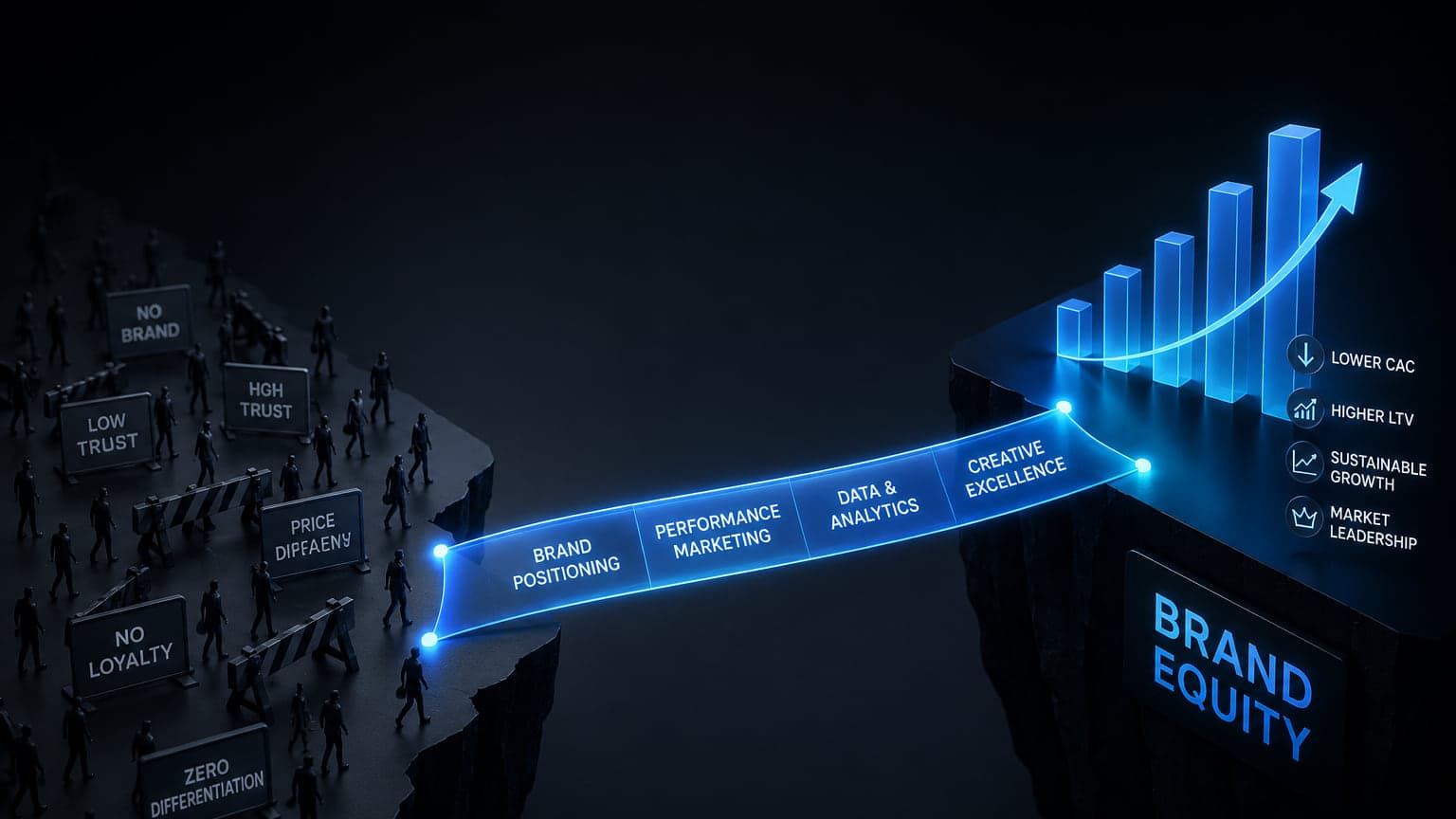
Every founder who calls us with a performance problem tells the same story. The account worked for eleven months. Then costs climbed, creative stopped landing, and the fix that used to work, more budget and more ad variations, stopped working. They want a media buyer. Usually they need a brand.
This is not a romantic argument. It is an arithmetic one.
Arbitrage always closes
When a channel is new, it is mispriced. Early Meta was mispriced. Reels were mispriced for about eighteen months. Right now WhatsApp flows are still mispriced for a lot of categories. If you were early, you looked like a genius. You were early.
What happens next is predictable. Competitors find the same audience, the auction fills, CPMs rise, and the only brands that hold their cost per acquisition are the ones a customer already recognises. Recognition is the discount. Everything else is bidding.
Across the accounts we run, the pattern is consistent enough to plan around: brands with meaningful branded search volume pay noticeably less for the same non-branded click, and their cold-traffic CTR sits well above category average. Same targeting. Same budget. The difference is that the person scrolling has seen the name before.
What brand actually means operationally
Brand is not your logo. It is not a moodboard. As a working definition inside a growth plan, brand is three assets you can audit.
- Distinctiveness. Could someone identify your ad with the logo cropped out? Colour, typography, a recurring face, a sonic mark, a format. Most Indian D2C ads are interchangeable, which is why they need to shout.
- A specific position. Not "premium quality at affordable prices." Something a competitor would refuse to say. Positioning that nobody could disagree with is not positioning.
- Consistency across time. A rebrand every fourteen months resets memory to zero. Consistency is boring internally and valuable externally. Every strong brand feels stale to the team that made it long before it registers with the market.
The split we actually recommend
The commonly cited long-term to short-term split is 60/40. For most Indian challenger brands under ₹50 crore, we run something closer to this.
| Stage | Brand-building | Activation | What we watch |
|---|---|---|---|
| Pre product-market fit | 10% | 90% | Repeat rate, qualitative feedback |
| Scaling, ₹1–5 cr revenue | 25% | 75% | Branded search trend, cold CTR |
| ₹5–25 cr revenue | 35% | 65% | Direct traffic share, CAC stability |
| Category leader | 45% | 55% | Price premium, unaided recall |
Spending on brand before you know the product works is expensive theatre. Refusing to spend on it after you have proven the product is how you cap yourself at ₹8 crore and stay there.
How to test brand without waiting three years
The objection is always measurement. Fair. Here is what we track monthly, all of it cheap.
- Branded search volume. The cleanest proxy that exists. If it is flat while spend rises, you are renting demand, not building it.
- Direct and organic share of sessions. Rising share means the brand is doing work the ads are being credited for.
- Cold audience CTR over time. Brand shows up as an efficiency gain in prospecting, months before it shows up in revenue.
- Repeat purchase rate at 90 days. Product quality and brand memory both live here.
- Post-purchase survey. One question at checkout: where did you first hear about us. Messy data, but the free-text answers are worth more than most dashboards.
If your branded search is flat and your paid spend has doubled, you do not have a growth engine. You have a subscription to Meta.
What we cut first
A brand-first approach does not mean spending more. It usually means spending differently. In most audits we recommend cutting these before anything else.
- Retargeting budgets aimed at people who would have bought anyway. Cut it 50% for two weeks and read incremental revenue, not attributed revenue.
- Discount-led creative that trains the market to wait for your sale. Nykaa and Myntra taught an entire generation of shoppers to wait. You are not big enough to survive that habit.
- Fifteen slightly different agency-produced statics a month. Three excellent, distinctive assets outperform them consistently.
- Any campaign whose whole idea is a trending audio. Borrowed attention does not accrue to you.
The Bengaluru problem
We sit in Indiranagar, surrounded by brands that all sound the same. Same founder-story reel, same muted palette, same claim about clean ingredients or Indian craftsmanship. When the category converges visually, the only lever left is price, and price wars end one way.
Distinctiveness costs nothing extra to produce. Choosing a colour nobody in your category owns costs the same as choosing beige. Committing to one recurring visual device costs the same as changing it every quarter. What it costs is the internal discipline to not get bored.
Where to start
Audit your last twenty ads with the logo cropped out. If your team cannot tell them apart from a competitor's, fix that before you touch bids. Then pick one distinctive asset you will not change for eighteen months and put it in every single frame.
If you want to pressure-test your position before spending another rupee against it, we run a free strategy call from our Indiranagar studio. Bring your last quarter of creative and your branded search trend. We will be direct about whether you have a brand problem or a media problem, because they need completely different budgets.